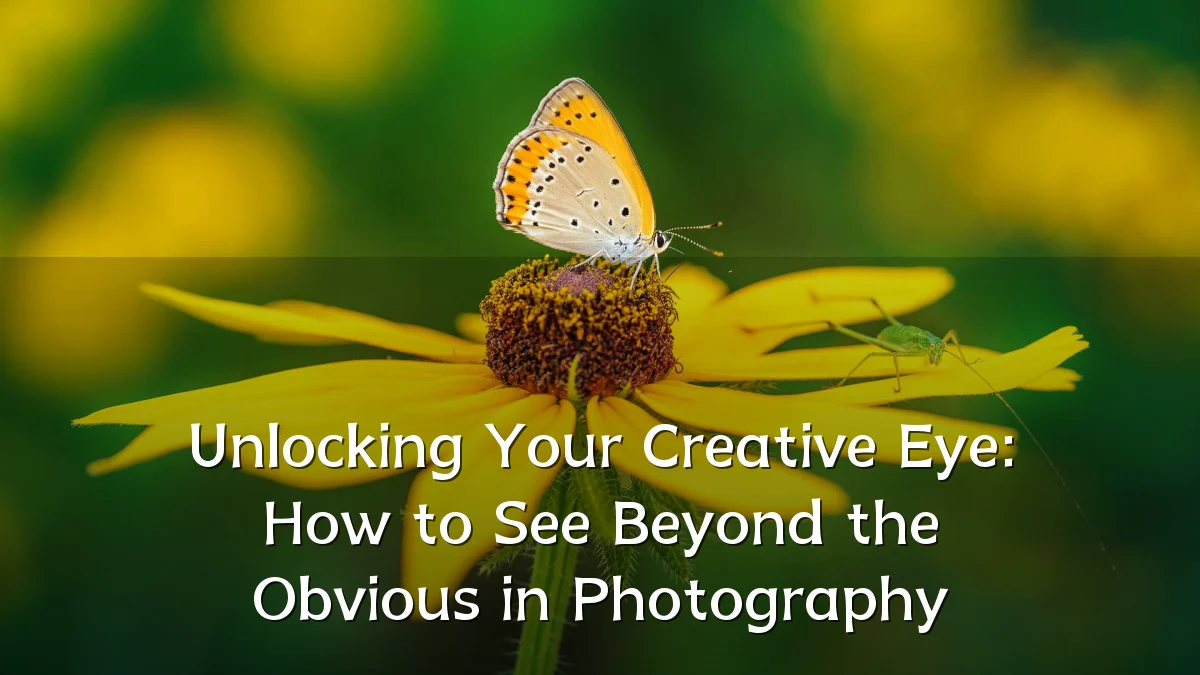
Unlocking Your Creative Eye: How to See Beyond the Obvious in Photography
Recent Trends in Creative Photography
Over the past few shooting seasons, a shift has emerged among both amateur and professional photographers: a move away from gear-centric technique and toward perception-based practice. Social media feeds once dominated by crisp, technically flawless images are now sharing space with deliberately imperfect, story-driven frames. Workshops and online communities increasingly emphasize "seeing differently" over buying better lenses. Photographers are experimenting with unconventional angles, minimal color palettes, and negative space as a compositional tool rather than an afterthought.
Background: The Limits of Technical Perfection
For decades, photography education focused heavily on exposure triangles, sharpness, and rule-of-thirds grids. While these fundamentals remain valuable, many practitioners have noted that technical mastery alone rarely produces memorable images. The concept of a "creative eye" — the ability to find visual interest in ordinary scenes — has been discussed by influential photographers since the mid-20th century, but it is now gaining renewed attention as smartphone cameras narrow the technical gap between devices. Critics argue that the industry’s past emphasis on equipment created a barrier for newcomers, while the current trend toward creative perception lowers that barrier and invites broader participation.
User Concerns: Overcoming Mental Blocks and Comparison Fatigue
Common struggles voiced in photography forums and surveys include:
- Feeling "stuck" in familiar locations: Many photographers report difficulty finding fresh subjects in their everyday environment, leading to repetitive work.
- Comparison with social media content: Seeing highly polished, curated feeds can create pressure to imitate rather than explore personal vision.
- Fear of breaking rules: Beginners often worry that abandoning composition guidelines will produce “bad” photos, even when intentional breaking can yield originality.
- Over-reliance on editing: Some users express concern that heavy post-processing masks an underdeveloped eye, and they seek authentic in-camera creativity.
Educators and experienced photographers respond by recommending structured exercises — such as shooting with a single focal length, limiting color choices, or setting time constraints — to build observation skills without the distraction of infinite options.
Likely Impact on Practice and Industry
If the trend toward creative-eye training continues, several consequences are plausible:
- Rise of visual-literacy courses: Photography education may increasingly include modules on perception, psychology of vision, and art history, rather than pure hardware tutorials.
- Shift in gear marketing: Camera and phone manufacturers could emphasize features that encourage experimentation (e.g., in-camera multiple exposures, variable aspect ratios) rather than pure megapixel counts.
- Greater diversity of portfolios: As more people learn to see beyond the obvious, the visual landscape — from journalism to fine art — could reflect a wider range of personal perspectives instead of formulaic aesthetics.
- Potential pushback from purists: Some traditionalists may argue that overemphasis on “creativity” devalues technical rigor, leading to debates within photography communities about what constitutes skill.
What to Watch Next
Observers should monitor several developments:
- Mobile app innovations: New tools that simulate visual constraints (e.g., fake black-and-white viewfinders, framing guides that block rule-of-thirds) may gain popularity as they train users to see differently.
- Exhibition and competition trends: Juries and gallery curators may increasingly favor conceptual or unconventional work over technically perfect but predictable images, signaling a shift in industry validation.
- Integration with other fields: Creative-eye principles could cross into street photography, documentary work, and even smartphone cinematography, blurring the lines between still and moving imagery.
- Long-term retention: Studies or surveys tracking whether perception-focused training leads to sustained creative growth — rather than short-lived inspiration — would offer valuable insight for educators and hobbyists.